
August 4, 2026 · Abeed Arefin
How does Maqam AI score recitation, and what does it actually measure?
How does Maqam AI score recitation, and what does it actually measure? How does Maqam AI help recite like your favourite Qari/reciter?
Last updated September 16, 2026
How Does Maqam AI Score a Recitation?
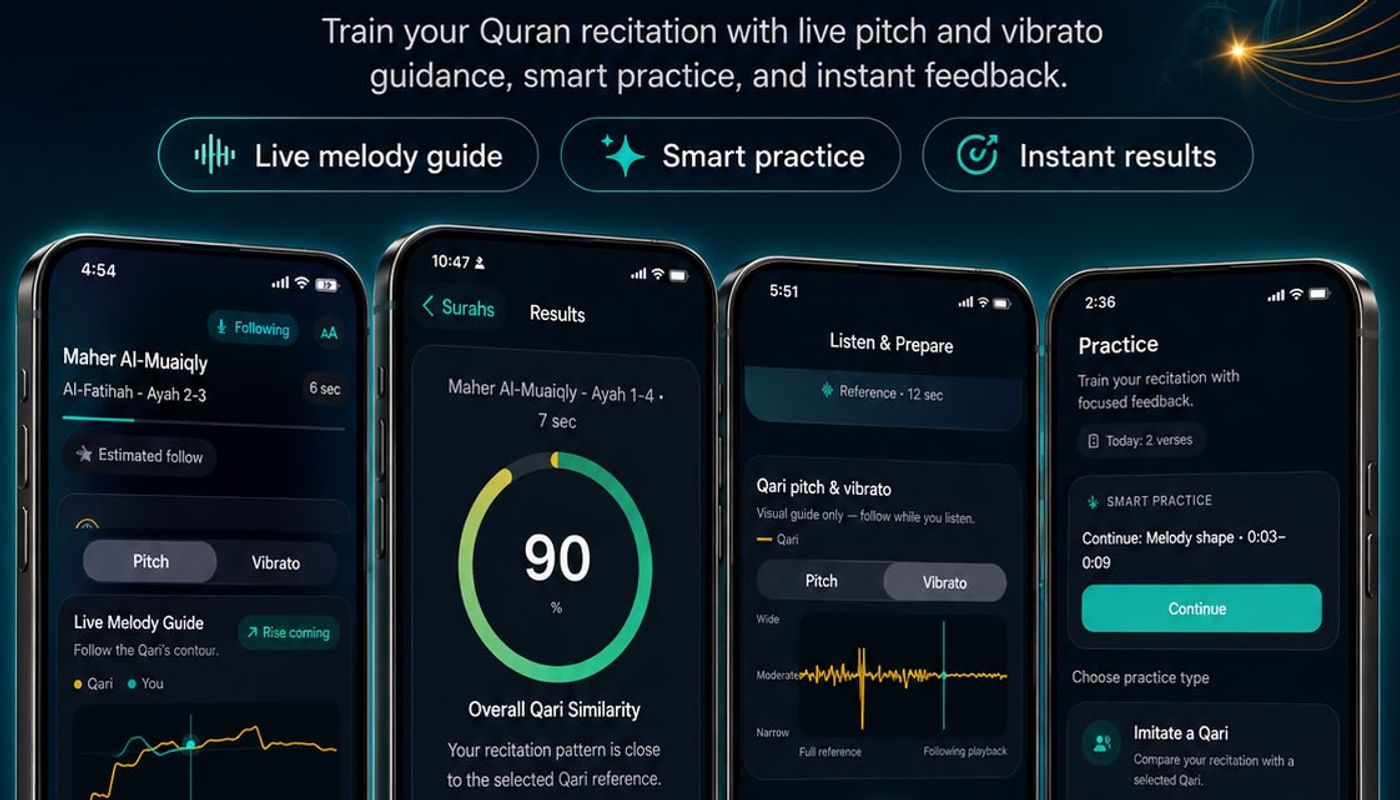
Maqam AI compares your recitation against a selected Qari's recitation and scores the differences across multiple dimensions instead of giving only a single overall rating.
The six public scoring dimensions are:
- Melody
- Pacing
- Pauses
- Endings
- Stability
- Vibrato
The goal is practical feedback. Rather than simply telling you a recitation was weaker, Maqam AI shows how it differed from the reference.
What Does Maqam AI Measure?
Maqam AI compares the sound and delivery of your recitation against a reference recitation.
In practical terms, it analyzes differences such as:
- When you started a phrase
- How quickly or slowly you recited each section
- Where you paused
- How long you held phrase endings
- Whether your melodic movement matched the reference
It is not presented as a religious judgment or certification system. Its purpose is recitation training through audible comparison.
What Does Each Score Mean?
🎵 Melody
Melody measures how closely your pitch movement follows the selected Qari.
For example, it may detect when you:
- Flatten a phrase the Qari raised
- Drop your pitch earlier than the reference
- Miss the shape of a repeated melodic pattern
⏱️ Pacing
Pacing measures timing throughout the recitation.
Differences may include:
- Starting a phrase late
- Rushing through a section
- Stretching a phrase longer than the reference
⏸️ Pauses
Pauses evaluate both where you stop and how long you pause.
This includes questions such as:
- Did you pause at the same place?
- Was your pause longer or shorter?
- Did you begin the next phrase at the expected time?
🎯 Endings
Endings focus on how phrases are completed.
Examples include:
- Ending too early
- Holding the final word too briefly
- Releasing the phrase differently from the reference recitation
🎙️ Stability
Stability is one of Maqam AI's public scoring categories, although the platform does not publicly provide a detailed technical definition.
A careful interpretation is that it reflects how steady and controlled your voice remains during recitation. Until more detailed documentation is published, it's best not to overstate exactly how this score is calculated.
🌊 Vibrato
Vibrato is also listed as a scoring dimension.
Based on the public product description, Maqam AI appears to compare vocal variation of this kind against the chosen reference recitation. The exact calculation method has not been publicly documented, so any explanation beyond that would be speculative.
Does Maqam AI Show Where Mistakes Happened?
Yes.
Rather than only producing a score, Maqam AI is designed to show where your recitation differs from the reference.
According to the product description, it aligns your recording with the selected Qari on a shared timeline and highlights the moments that diverge.
Instead of simply saying:
«"You scored lower."»
The feedback is closer to:
- This phrase ended early.
- This pause was shorter than the reference.
- This melodic rise didn't match.
That makes it easier to know exactly what to practice next.
Does Maqam AI Generate Practice Drills?
Yes.
According to the product, your analysis is turned into a personalized practice plan built around your weakest moments.
Examples include:
- Re-record the phrase with the weakest ending.
- Match the Qari's hold on the final word.
- Enter the next phrase after the pause at the correct timing.
The score isn't meant to be the finish line—it's meant to guide your next repetition.
Is Maqam AI Judging Tajwid Correctness?
No.
Maqam AI is publicly presented as a comparison tool that measures your recitation against a selected reference.
It does not claim to:
- Issue religious rulings
- Certify correctness
- Replace a qualified Qur'an teacher
A higher or lower score should therefore be understood as a comparison within the app's training framework, not as a religious verdict.
Does Maqam AI Help With Hifz?
Yes. Hifz is a separate track from scoring.
Imitate scores compare your sound to a selected Qari. They do not measure whether you remembered the ayah, and they do not certify memorization.
Hifz practice uses Flow (read, hide, recite one Mushaf page) and Hifz Coach (Listen → Echo → Recall → optional Prove). While you recite, Maqam checks words as you go. Yellow marks a word that could not yet be verified. Red marks a confirmed miss. That is live word-level error detection. The word trail is a reading and recall aid — it does not grade tajweed.
If you want to know whether your delivery is closer to a Qari, use Imitate scores. If you want to recall the page and catch missed words as you recite, use Hifz.
Is Maqam AI Useful If You Already Know the Ayah?
Yes.
For many reciters, memorization isn't the difficult part—refinement is.
Maqam AI is designed to help you:
- Sound closer to your chosen Qari
- Catch rushed endings
- Notice inconsistent pauses
- Build more consistent recitation over repeated practice
Can Beginners Use Maqam AI?
The public positioning suggests Maqam AI is not intended for complete beginners.
Someone still learning the Arabic letters, basic reading, or foundational recitation will likely benefit from traditional instruction first.
Maqam AI is positioned as a refinement tool for reciters who already have the basics and want detailed, measurable feedback.